

Mother of pearl design is one of the iconic hallmarks of Vietnamese craftsmanship. Its radiant, iridescent beauty has attracted luxury collectors and interior designers worldwide for decades. However, you must realize that no beauty is eternal. While the initial glow of mother of pearl is incredibly captivating, maintaining it requires specific methods.
Specifically, many people inadvertently damage their pieces due to improper care, storing them as simply as ordinary plastic or ceramics. Therefore, understanding the properties of this organic material is the only way to ensure your home furniture remains as bright as if it just left the workshop.
The following article will reveal special techniques used by master artisans to ensure even the most intricate details continue to shine. Let’s explore the organic characteristics of nacre, neutral pH cleaning methods, and the environmental factors that determine the lifespan of the shell’s luster.
Additionally, you will discover home polishing secrets and storage methods to protect the surface from natural decay. Whether you own a single tray or manage a global inventory of luxury furniture, this article can become the essential maintenance handbook you need.
Contents
- 1. Understanding the Organic Nature of Your Mother Of Pearl Design
- 2. Secret 1: The Gold Standard for Cleaning Mother Of Pearl Design
- 3. Secret 2: Protecting Your Mother Of Pearl Design From Environmental Stress
- 4. Secret 3: Professional Polishing to Restore the Original Shine
- 5. Secret 4 & 5: Proper Storage and Long-term Maintenance Habits
1. Understanding the Organic Nature of Your Mother Of Pearl Design
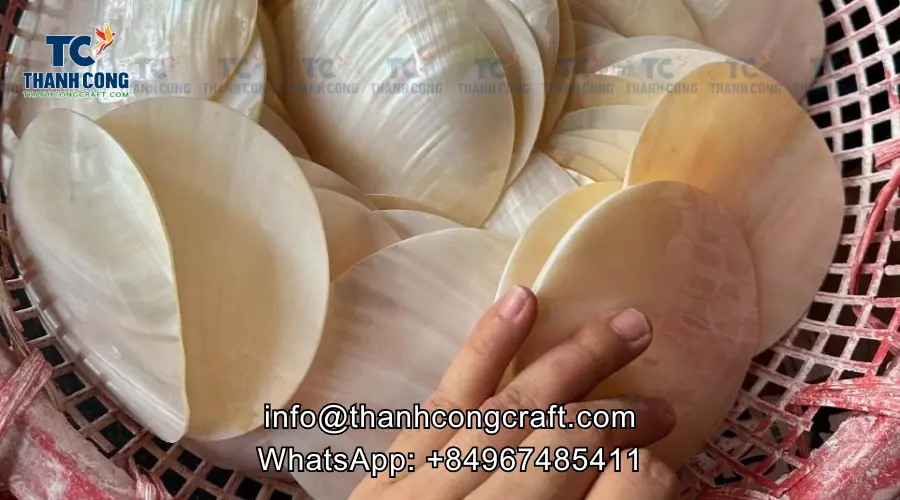
First, we must understand that mother of pearl is not a mineral; it is an organic-inorganic composite created by certain mollusks. Specifically, it is composed of hexagonal Aragonite (Calcium Carbonate) crystal plates stacked into a continuous layered structure, bonded together by a mixture of organic substances including elastic biopolymers like Chitin. It is this structure that creates light diffraction, giving the material its signature “iridescent” look.
However, this organic nature makes the surface of a mother of pearl design extremely sensitive to external factors. If you expose the product to harsh industrial cleaners or sudden temperature changes, the internal bonding agents can dry out or shrink. Once the moisture of the shell is altered, the iridescence will begin to fade and turn a dull, chalky white.
At ThanhCongCraft, our R&D team has spent hundreds of hours selecting shells with high structural density, ensuring the product meets standards for long-lasting brightness from the start. Additionally, we have a quality control department that checks the thickness of the inlay to ensure durability right from the material selection stage. Therefore, you can rest assured about the quality of our input materials.
Related post::What Must Chocolate Brands Consider When Changing Displays?
2. Secret 1: The Gold Standard for Cleaning Mother Of Pearl Design
Cleaning mother of pearl is a task where the motto “less is more” comes first, and you need to pay attention to the pH level when cleaning. Many current cleaners are too acidic (like vinegar) or too alkaline (like ammonia); both will cause a chemical reaction that corrodes the Calcium Carbonate structure of the shell.
This corrosion creates microscopic pits that cause light to scatter instead of reflect, meaning the piece will no longer be as shiny as before. Besides, cleaners containing abrasive particles will leave scratches, causing the surface to become opaque over time.
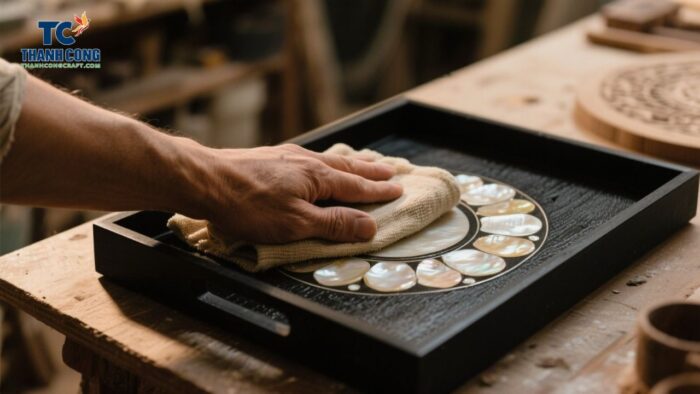
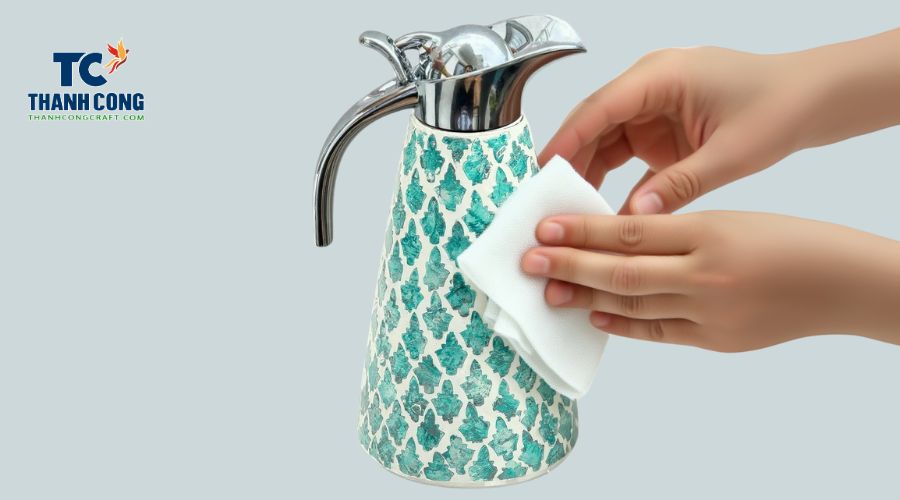
The tools you use are also very important. You should use high-quality, lint-free, and dust-free microfiber cloth, using warm distilled water to soften the cloth before cleaning. If the product is stuck with grease or stubborn stains, you can use a little dish soap with a pH of about 5.5-6.5. Note that you should wipe in a circular motion and dry immediately to avoid water spots. Especially with intricate mother of pearl design patterns, prioritize using a soft-bristled brush to sweep away dust before you start wiping.
| Category | Recommended Method | Risks of Improper Care |
| Cleaning Agents |
– Distilled water (Tesco De-Ionised Water, CarPlan De-Ionised Water, ASDA De-Ionised Water…) – pH-neutral soap (Method Multi-Surface Cleaner, Dove Beauty Bar…) |
Acidic/Alkaline cleaning agents damage the natural structure of the shell |
| Cleaning Tools | Microfiber cloth | Paper towels or abrasive pads will cause surface scratches |
| Moisture | Dampen only, do not soak in water | Excess water can seep into the protective lacquer layer and alter the natural moisture |
| Frequency | Weekly dusting | Infrequent cleaning allows dirt to build up, leading to surface abrasion over time |
Read more: 5 Reasons Why Mother of Pearl Outshines Gold & Glass
3. Secret 2: Protecting Your Mother Of Pearl Design From Environmental Stress
One of the key factors in keeping mother of pearl radiant is controlling the surrounding environment. If you leave your mother of pearl design items in direct sunlight for a long time, UV rays will trigger photochemical reactions that change the color of the shell and the protective lacquer layer. As a result, the white and blue hues of the product will turn an unappealing yellow or brown.
Additionally, if you place the product near a heater or chimney, the heat can cause the wooden core and the shell inlay to expand at different rates, leading to “crow’s foot” cracks or tiny fissures on the surface.
Humidity also plays an extremely important role. The nacre layer needs an environment with stable humidity (ideally 40-60%). However, note that if kept in conditions that are too dry, the organic mixture of the shell can become brittle and fragile. Therefore, you should keep the product in a cool, airy place, away from heater vents and South-facing windows.
At ThanhCongCraft, we always focus on the production process, including meticulous wood core treatment to prevent warping and pests, but the deciding factor for durability is the user’s preservation. Please avoid placing wet objects directly on the surface as they can cloud the protective lacquer.
4. Secret 3: Professional Polishing to Restore the Original Shine
After some time, you may notice the outer lacquer of your mother of pearl design showing signs of dullness. This is completely normal and can be solved simply by “polishing” it yourself at home.
However, note that this method does not use abrasive industrial polishes, but rather a “nourishing” technique with natural oils. Applying a tiny amount of high-quality natural oil, such as coconut oil or pure olive oil, allows it to penetrate the microscopic pores of the lacquer and shell, filling gaps and protecting the product.
Specifically, put one drop of oil on a soft cloth and rub gently in a circular motion. Leave it for about 10 minutes for the oil to penetrate, then wipe off any excess oil thoroughly with another clean cloth. This process “moisturizes” the organic layers, restoring color depth and making the shell grain shine like new. It also creates a temporary hydrophobic film that helps your product resist dust and fingerprints.
At ThanhCongCraft, our artisans perform this “moisturizing” step before packaging and delivering the product to you. So when you receive it, you can be sure it will retain its radiant color for many years.
Related post: Why Are Decorative Trays More Than a Display Surface for Gifting?
5. Secret 4 & 5: Proper Storage and Long-term Maintenance Habits
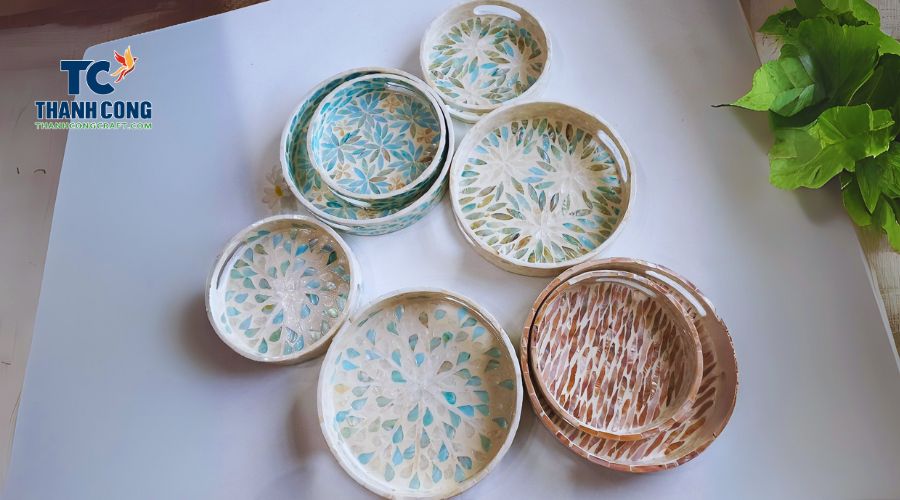
Mother of pearl is relatively soft (low on the Mohs hardness scale), so it is easily scratched by cutlery, jewelry, or other ceramics. Therefore, when storing these items, wrap each piece in soft cotton or felt. Furthermore, never stack mother of pearl plates or trays directly on top of each other; add a liner between them to prevent scratches.
Maintaining stable humidity is crucial. Storing mother of pearl for a long time in a damp basement, attic, or humid bathroom/kitchen is a serious mistake. Stagnant air leads to mold growth under the lacquer, leaving permanent stains on the shell.
Store these products in a controlled, ventilated area with stable temperature and humidity, avoiding dampness and suffocation. Especially, do not use plastic wrap for long periods as it traps moisture and causes the surface lacquer to become cloudy.
Read more: How to Preserve Mother-of-Pearl Inlay Trays During the Rainy Season
Reach out to us today to learn more about our products or to place a wholesale order. We look forward to connecting with you!
- Thanh Cong Handicraft Co., Ltd
- Email: [email protected]
- Tel/WhatsApp: +84967485411
Explore our Products Collection for more choices! Contact Us!


