

Bamboo quality is one of the most important factors for Vietnamese bamboo to be exported to demanding markets and sold in luxury showrooms in London or New York. With nearly 100 years of experience in exporting handicrafts, We have realized that many people still confuse “quality” with the external appearance of the product.
In fact, quality is the ability to withstand changes in the climate and environment, measured by the durability of the product’s characteristics—such as being hard or soft—during use. Therefore, if you are looking to import goods, please care about product quality instead of just focusing on design and use. Good quality products are not just an advantage, but also a deciding factor in the survival of a business.
This article will provide you—the person looking to import bamboo products—with an understanding of the bamboo production process in Vietnam, and the complexity and meticulousness required to create a finished bamboo product. The production process is divided into 4 steps, from choosing natural bamboo to pre-processing techniques and finishing with modern, advanced technologies that meet global standards.
Additionally, you will understand more about the internal quality control standards at ThanhCongCraft to create mass-produced products with consistent quality. Finally, you will be equipped with strategic knowledge to distinguish between “low-end,” common souvenirs and “export-grade” products.
Contents
- 1. Evaluating Biological Maturity for Bamboo Quality
- 2. Verifying Curing and Anti-Pest Treatment
- 3. Scientific Moisture Content (MC) Management
- 4. Assessing Artisanal Precision and Finishing
- 5. The Final Frontier of Quality Assurance
- 6. Compliance, Ethics, and Long-Term Profitability
- 7. Future Trends: Innovation in Bamboo Material Science
1. Evaluating Biological Maturity for Bamboo Quality
The first factor to consider whether bamboo quality is superior or not is based on the age of the tree at the time of harvest. Unlike wood, which has a long harvest time of several decades, bamboo has a very narrow window of time to provide the best quality.
1.1. The 3-5 Year Maturity Rule
Vietnam has many rich bamboo forests. To meet the low-price demand of the market, many small workshops harvest bamboo too early, at the 1-2 year mark. However, young bamboo is very weak; inside the stalk is a mixture of water and natural starch. This mixture acts like a magnet that attracts powderpost beetles and mold. This is the reason why some bamboo objects break easily, get termites, fade in color, and ruin quickly.
At ThanhCongCraft, we only harvest bamboo between 3 and 5 years old. This is the ideal maturity for production. Since the bamboo has undergone the lignification process, the fibers harden, creating a dense structure like bone that can withstand weight and high intensity of use.
1.2. Choosing Characteristics by Species
You might not know this, but there are many types of bamboo, and not every type is hard, durable, and flexible enough. The species will decide the quality of the bamboo. For example, the species Bambusa stenostachya (locally called Tre Gai) is highly valued for its thick walls and incredible tensile strength, making it the ideal material for heavy-duty furniture. Additionally, Dendrocalamus barbatus is the bamboo species often used for items requiring large diameters and sizes.
When importing bamboo, our team conducts checks on the distance between nodes and the wall thickness of every order before it enters the processing stage to ensure it meets the structural standards of ThanhCongCraft.
2. Verifying Curing and Anti-Pest Treatment
After harvesting, the next factor deciding bamboo quality is how the raw material is preserved and treated. Raw bamboo is like a living organic “grass”; we need to use professional techniques to stabilize its quality, ensuring a long lifespan through different climate conditions.
2.1. Carbonization Method
Soaking in toxic preservative chemicals is a taboo that affects the environment and users; ThanhCongCraft never uses this method. Instead, we use a high-pressure steaming technique, also known as Carbonization. This method exposes the bamboo to high temperatures, where the sugar and starch are “cooked” and separated from the material. Without sugar and starch, bamboo has the ability to resist insects naturally without using harmful pesticides. Furthermore, using this method keeps the natural characteristic color of the bamboo permanently, enhancing the aesthetic quality both inside and out.
2.2. Traditional Natural Soaking
For some traditional product lines, we use a method passed down from our ancestors, which is soaking bamboo in mud and running water for several months. This is a traditional method that effectively prevents termites. The fermented bamboo removes the nutrients that pests love, thereby increasing the durability, toughness, and load-bearing capacity of the bamboo.
Learn about: What Happens When Bamboo Products Get Wet?
3. Scientific Moisture Content (MC) Management
If you ask any manufacturer, importer, or exporter about the biggest threat to bamboo quality, the answer is always “moisture.” Managing bamboo moisture is the line between a successful, profitable shipment and a container full of mold that must be thrown away as soon as it reaches the port.
3.1. The Gold Standard: 8% – 12% Moisture
To strictly control moisture, we decided to invest heavily in industrial kiln-drying facilities. Bamboo exported to European and US markets must ensure a stable moisture level of 8-12%. If the moisture is higher, the product will “sweat” inside the container during the long journey at sea, leading to the growth of mold. Additionally, if dried too quickly, the bamboo will suffer internal stress and cracks will appear.
| Feature | Export Grade (Kiln-Dried) | Domestic Grade (Air-Dried) |
| Moisture Content | 8% – 12% (Strictly Controlled) | 18% – 25% (Variable) |
| Crack Resistance | High (Internal stresses neutralized) | Low (Prone to splitting) |
| Mold Risk | Near Zero (with proper packaging) | High (during long transit) |
| Stability | Dimensions remain consistent | Prone to warping and shrinkage |
3.2. Environmental Stress Testing
Drying bamboo is not the only way to control moisture. To control it more strictly and improve bamboo quality, we also test its stress in different environments. Specifically, climate-controlled rooms simulating dry heat in Western homes, or cold, damp, and wet weather in different regions are used to test the quality of the bamboo and observe its reaction to extreme weather. Only after passing these tests has the bamboo achieved stable quality to be sustainable despite different difficult environments.
4. Assessing Artisanal Precision and Finishing
The final step in verifying bamboo quality is based on human hands. Machines are used to dry and treat the raw materials, but the level of finish, product quality, “soul,” and safety can only be clearly understood by skilled artisans.
4.1. Tension of Weaving and Symmetry
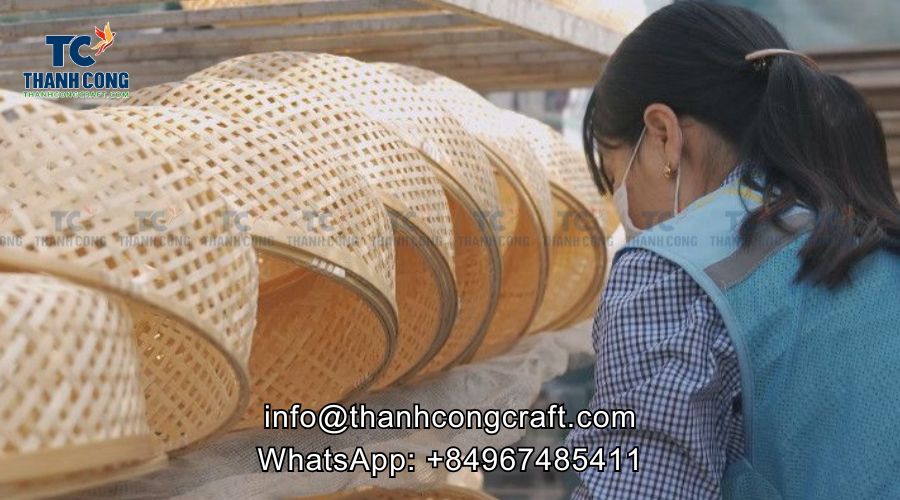
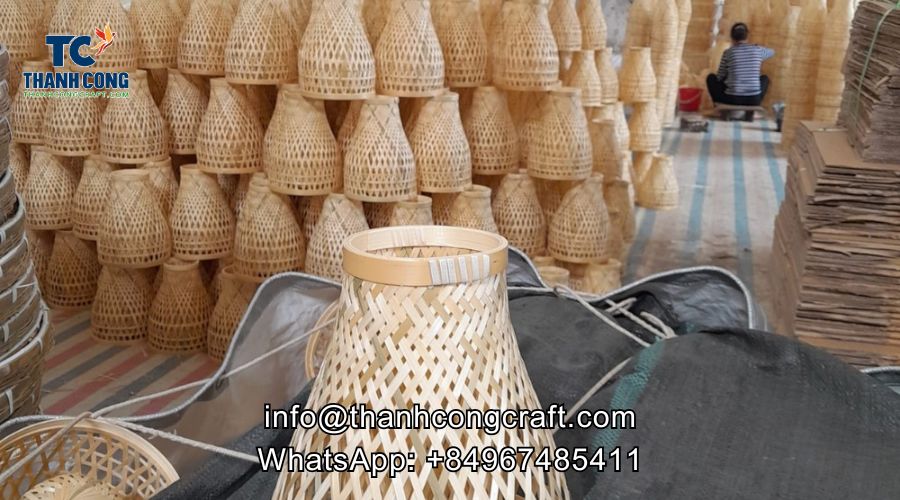
For bamboo baskets and lamps, uniform tension between products plays an important role. If the artisans weave too loosely, the product will sag and lose its shape over time. Our quality control department works strictly to ensure the joints are symmetrical, even, smooth, and hold their shape. Additionally, the quality of the bamboo fibers used for weaving must ensure there are no burrs or splinters, and no “peeling” of the bamboo skin—a sign of low-quality bamboo.
4.2. Non-Toxic Finishing Standards
Furthermore, the final glossy finish is highly prioritized; it must be perfect and safe for users. This is not only the part that protects the bamboo inside, but also the surface in direct contact with people’s hands, the air, and food. We use water-based paints that are food-safe and meet REACH and FDA standards. A high-quality finish must protect the bamboo but not make it look artificial. Besides, “adhesion” tests on the bamboo are also performed to ensure it does not peel over time.
Find out more: Can Bamboo Products Survive Humidity Without Mold?
5. The Final Frontier of Quality Assurance
The process of checking bamboo quality does not stop at the workshop. When shipping orders to customers, climate conditions and humidity have a great impact on quality. Therefore, we always closely monitor the entire shipping process, ensuring the bamboo quality does not change until it reaches the customer.
Advanced Packaging Rules
In each box, we use 5-layer cardboard cartons to prevent impact, along with silica desiccant packs to ensure moisture levels. At the same time, we must ensure the pallets can “breathe”—meaning they are not packed too tightly, causing blockage and preventing air circulation, which increases moisture. Additionally, the process of loading goods into containers is also focused on, ensuring each box is dry, not wet or damp, which is an important prerequisite for the product to safely cross the ocean.
Container Desiccants and Air Circulation
Additionally, for some special orders, industrial desiccant bags for containers are put into use. These bags absorb liters of water from the air inside the steel container when passing through the hot equator. This way, the bamboo quality is preserved in a “dry chain” from the time it leaves the kiln until you open the container door at the destination.
6. Compliance, Ethics, and Long-Term Profitability
Bamboo quality is not only defined by itself but also relates to legal issues and its ethical footprint globally. Specifically, it relates to the ability to export/import and the transparency of the bamboo’s origin.
Navigating Legal Compliance
If you specialize in importing bamboo and bamboo products, you surely know about and comply with the Lacey Act and the European Union Timber Regulation (EUTR). These laws require paperwork and evidence showing that the bamboo was harvested legally. Therefore, suppliers who cannot provide full traceability documents are considered to be providing poor-quality bamboo.
At ThanhCongCraft, we maintain full traceability for all raw materials used, so your legal team can rest easy if they need documents for proof.
ROI from Superior Bamboo Quality
For business owners, the decision to prioritize bamboo quality is a matter of financial strategy. Buying “cheap” bamboo is often an expensive mistake an importer can make due to high return rates. But when you buy premium bamboo, return and complaint rates can drop significantly—often from 5% to less than 0.5%. Additionally, this helps you maintain higher profit margins and have time to develop your brand instead of handling defective orders.
Explore more: Bamboo Product List for Interior Design: From Basket to Furniture
7. Future Trends: Innovation in Bamboo Material Science
Today, the definition of bamboo quality is constantly evolving along with technological progress. New technologies help global development, and applying new technology to protect bamboo quality is also one of the concerns of major companies.
Protection with Nano Technology and Smart Manufacturing
ThanhCongCraft is currently testing new technologies, such as using Nano coatings that are completely waterproof and plant-based. These coatings allow bamboo to be used in high-humidity environments like bathrooms for many years without mold or quality loss. Additionally, digital technology will gradually be applied to the quality control line to track the finish and moisture of bamboo products that the human eye or hand cannot easily recognize.
Accordingly, as production scale grows, the bamboo quality of ThanhCongCraft is increasingly guaranteed, and your brand will become more reputable and lead the industry.
Reach out to us today to learn more about our products or to place a wholesale order. We look forward to connecting with you!
- Thanh Cong Handicraft Co., Ltd
- Email: [email protected]
- Tel/WhatsApp: +84967485411
Explore our Products Collection for more choices! Contact Us!


